Welcome to the Real Madrid Fan's Web Page
How it all started
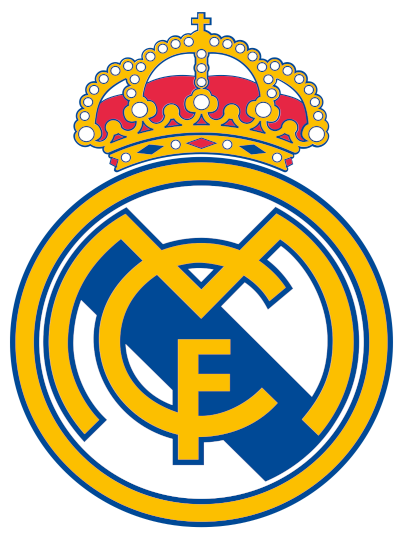
Football was introduced to Madrid by students of the Institución Libre de Enseñanza. They included several Oxbridge graduates. In 1897, they founded a club called Sky, playing on Sunday mornings at Moncloa. In 1900, they split into two different clubs: New Foot-Ball de Madrid and Madrid Football Club. On 6 March 1902, after a new Board presided by Juan Padrós had been elected, Madrid Football Club was officially founded and over the next few years won four consecutive Copa del Rey titles, which was the only nationwide competition at that time.
In 1912, they moved to a ground called Campo de O'Donnell, after previously moving between some minor grounds. In 1920, the club's name was changed to Real Madrid after King Alfonso XIII, a reputed football fan, granted the title of real ("royal" in English) to the club. When the Second Spanish Republic was proclaimed in 1931, however, the club dropped both the word Real and the royal crown from the emblem, being known from then on and until the end of the Spanish Civil War as Madrid C.F. only. The addition of the purple band to the emblem dates back to the Republican period and has remained there ever since.
The importance of Santiago Bernabéu
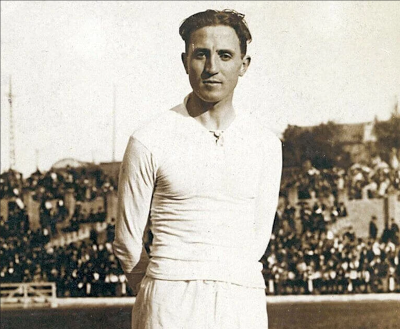
Before becoming president in 1945, Santiago Bernabéu Yeste had already carried out the functions of player, first‐team captain, club maintenance, first‐team manager and director in an association with the club that would last nearly 70 years. He was responsible for rebuilding the club after the Civil War and under his presidency the construction of the Santiago Bernabéu Stadium and the Ciudad Deportiva.
Finally, beginning in 1953, Bernabéu embarked upon a strategy of signing world‐class players from abroad, the most prominent being the Argentine Alfredo di Stéfano, and built the world's first truly multinational squad. During Bernabéu's presidency, many of Real Madrid's most legendary names played for the club, including Di Stéfano, Ferenc Puskás, Francisco Gento, Héctor Rial, Raymond Kopa, José Santamaría, Miguel Muñoz, Amancio and Santillana.
It was under Bernabéu's guidance that Real Madrid became established as a major force in both Spanish and European football. Before passing away in 1978, Bernabéu had been the club's president for 33 years, during which Real won one Intercontinental Cup, six European Cups, 16 La Liga titles and six Spanish Cups.
Glorious Moments
La Quinta del Buitre
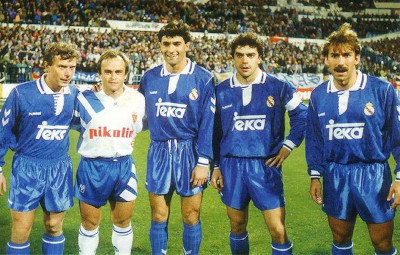
It was the name given by Spanish sport journalist Julio César Iglesias to the five homegrown Real Madrid players who were at the core of the team that dominated Spanish football in the 1980s. The name, meaning Vulture's Cohort in English, was derived from the nickname given to its most charismatic member, Emilio Butragueño. The other four members included Manolo Sanchís, Martín Vázquez, Míchel and Miguel Pardeza.
Sanchís and Martín Vázquez were the first to play for the first team of Real Madrid, making their debut at Murcia on 4 December 1983 under coach Alfredo Di Stéfano. Both played surprisingly well, with Sanchís scoring the game's winner. A few months later, on 5 February 1984, Butragueño debuted in an away match at Cídiz. El Buitre was an instant sensation and scored twice. Pardeza was added to the first team that same season and Míchel followed at the start of the next.
With La Quinta del Buitre (reduced to four members when Pardeza left the club for Zaragoza in 1986), Real Madrid had one of the best teams in Spain and Europe during the second half of the 1980s, winning, amongst others, two UEFA Cups and five Spanish championships in a row. Their record was only blemished by their failure to win the European Cup, and their continued abject defeats against the far superior Milan side of the time.
Los Galácticos
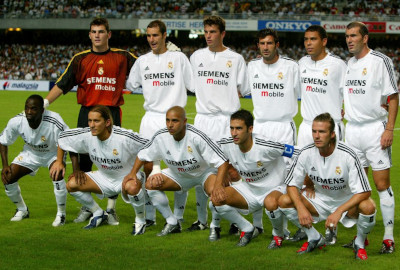
Though Real Madrid had already won two European Cups in 1998 and 2000 under the presidency of Lorenzo Sanz, Sanz lost his re-election bid to Pérez. Pérez won by promising an aggressive new transfer policy and expensive new signings, in particular, Luís Figo from rivals Barcelona.
After the purchase of Figo for €62 million, a world‐record transfer fee, Pérez sought to buy at least one world‐class superstar player (dubbed a galáctico) each summer. The record was broken a year later by the purchase of Zinedine Zidane from Juventus for €75 million. After a demand for youth integration in the side, which coincided with the appointment of Vicente del Bosque, the policy was redubbed as Zidanes y Pavones, with the name deriving from Zidane and Francisco Pavón, a product from the club's youth academy — the idea was to sign one major superstar per year, and promote youth players sporadically.
Immediate success followed for three seasons, with Real winning La Liga in 2000‐01 and 2002‐03, and claiming the UEFA Champions League in 2001‐02, with Zidane scoring the winning goal in the final. After winning the 2002‐03 La Liga title, Real Madrid added English midfielder David Beckham from Manchester United for €35 million.
Some of the most important players of this era were; Luís Figo, Zinedine Zidane, Ronaldo, David Beckham, Michael Owen, Robinho, Sergio Ramos, Fernando Hierro, Raúl, Guti, Roberto Carlos, Fernando Morientes, Iván Helguera, Míchel Salgado, Steve McManaman, Nicolás Anelka, Iker Casillas and Claud Makélélé.
La Décima & More
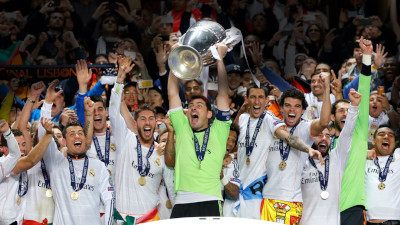
On 25 June 2013, Carlo Ancelotti became the manager of Real Madrid after signing a three‐year deal. A day later, he was introduced at his first press conference for Madrid, where it was announced that both Zinedine Zidane and Paul Clement will be his assistants. On 1 September 2013, the long‐awaited transfer of Gareth Bale from Tottenham Hotspur was announced, with Bale joining Karim Benzema and Cristiano Ronaldo in the Madrid attack. The transfer of the Welshman was reportedly a new world record, with the transfer price around €100 million. In Ancelotti's first season at the club, Real Madrid won the Copa del Rey, with Bale scoring the winner in the final against Barcelona. On 24 May 2014, Real Madrid defeated city rivals Atlético Madrid in the Champions League Final, winning their first European title since 2002, and they became the first team to win ten European Cups, an achievement known as La Décima. Real Madrid's attacking trio the BBC, finished the season with 97 goals.
On 4 January 2016, it was announced that Benítez was sacked and replaced by Zinedine Zidane. On 28 May 2016, Real Madrid defeated city rivals Atlético Madrid in the Champions League Final, winning their eleventh European title. On 3 June 2017, Madrid won the 2017 UEFA Champions League Final 4‐1 against Juventus, with two goals from Ronaldo and goals from Casemiro and Asensio, to win their second consecutive and twelfth overall title. With that win, Madrid became the first team to defend their title in the Champions League era. Real Madrid won the Champions League for the third time in a row by defeating Liverpool 3‐1, becoming the first team to achieve that feat since 1976.
Some of the most important players of this era were; Kaká, Karim Benzema, Cristiano Ronaldo, Xabi Alonso, Ángel Di María, Luca Modrić, Gareth Bale, Toni Kroos, James Rodríguez, Iker Casillas, Sergio Ramos, Pepe, Marcelo, Gonzalo Higuaín, Mesut Özil Raphaël Varane, Dani Carvajal, Isco, Casemiro, Keylor Navas and Marco Asensio.