Take a look to our amazing Stadium
Santiago Bernabéu
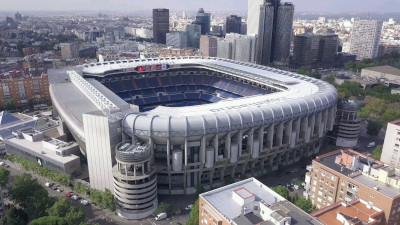
The Civil War broke out on 18 July 1936, and its effects on the Old Chamartín were significant, leaving it in a dreadful state. To repair the extensive damage it was necessary to invest an important sum of money. In October 1939 it was reopened for the first post‐war derby, in which the Whites beat Atlético Madrid 2‐1. The fans' enthusiasm did not wane with the military conflict and the ground was at full capacity. After successive refurbishments, the stadium's capacity was increased to 25,000 fans, but this was not sufficient to attend to the large demand.
Santiago Bernabéu, who for a long time dreamt of building a new stadium, made it a reality in 1943 when he ascended to the presidency. He began construction on a major project that some deemed overly‐ambitious, a pharaonic stadium with capacity for 100,000 fans. An impressive stadium that would bear witness to some of the most brilliant pages in the history of Real Madrid. The New Chamartín Stadium became the best ground in Europe and one of the most modern in the world. It was inaugurated in December of 1947, with a victory over the Portuguese champions, Os Belenenses (3‐1). Barinaga scored the first goal at the new stadium.
The stadium of the future
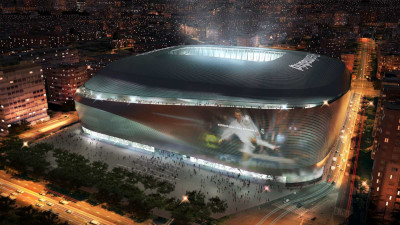
The Santiago Bernabéu is set to undergo a facelift which will ensure that the arena continues to be a global benchmark within the worlds of sport and architecture. According to Florentino Pérez, The new stadium will continue to be the setting that generates the emotions which will leave their mark on Real Madrid's future. It'll be the best stadium in the world in which to see us once again recognised at the end of the century as the best club of the 21st century. It'll offer a new stadium, heritage and be a new source of pride for our members and fans.
The redevelopment will see the Santiago Bernabéu become a digital arena, in which technological advances and the use of audio‐visual tools will be available across many areas of the stadium. For example, fans will be able to enjoy club‐generated content that enhances their matchday experience on their mobile phones and tablets, in what is known as the use of a second screen.
The project will also bring about improvements to the stadium's urban setting, with a large square, of over 20,000m2, to be built on the Paseo de la Castellana, and another measuring 5,500 m2 on the corner of Padre Damián, which will see the calle Rafael Salgado become pedestrianised. There will be improvements in terms of security, accessibility and evacuation for all supporters, given that the stadium will be equipped with more entry points. The current shopping centre is set to be demolished and two new towers will be erected on the Castellana, complete with ramps, escalators and lifts. The movement of supporters will also be more fluid, thanks to the instalment of new escalators along the Castellana and Padre Damián which will serve the stadium's highest points.